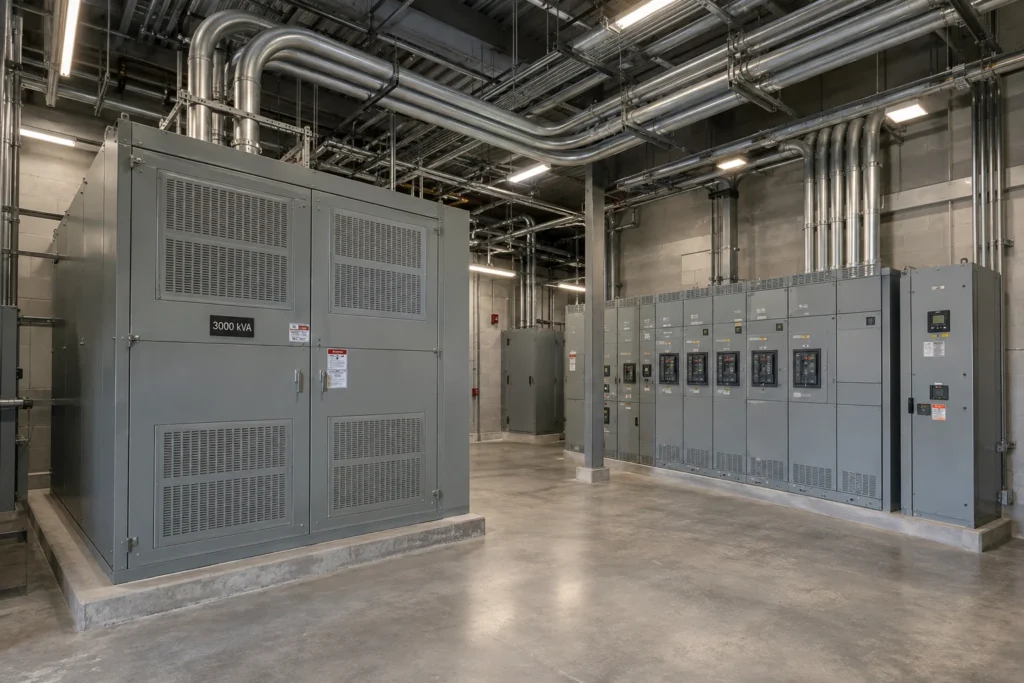
A facility’s fault-current levels depend on the electrical sources and the network between them and the equipment. A new transformer, utility change, or additional generation can alter those levels. A study gives your team a documented basis for evaluating equipment ratings.
WHAT WE EVALUATE
A scope built around your system.
Source & network review
Collect utility fault data, transformer characteristics, conductor information, and relevant motor or generator contributions.
Fault-current calculations
Evaluate the fault types and operating arrangements appropriate to the system and project scope.
Equipment-duty checks
Compare calculated duty with available equipment ratings and identify locations that require further investigation or corrective action.
WHAT YOU RECEIVE
Findings your team can use.
01
Documented source data and calculation assumptions
02
Fault-current results at the agreed system locations
03
Equipment-duty evaluation and identified concerns
04
Recommendations to support equipment selection or upgrades
What helps us get started
Bring the latest one-line, utility service information, transformer nameplates, equipment ratings, and the proposed changes. Where records are incomplete, the scope can include a plan to gather the missing data.
BEFORE WE BEGIN
A clearer starting point.
Can the study support equipment replacement?
Yes. The results provide an engineering basis for reviewing interrupting and withstand requirements, alongside the other criteria involved in equipment selection.
Is this the same as an arc-flash study?
No. Short-circuit analysis evaluates fault current and equipment duty. Arc-flash analysis addresses incident energy and related hazards; it often uses short-circuit results as part of a broader model.
LET’S TALK ABOUT YOUR FACILITY
Make your next decision with confidence.
Tell us about your facility, your existing information, and the decision you need to make. We’ll help define the right study or design scope.